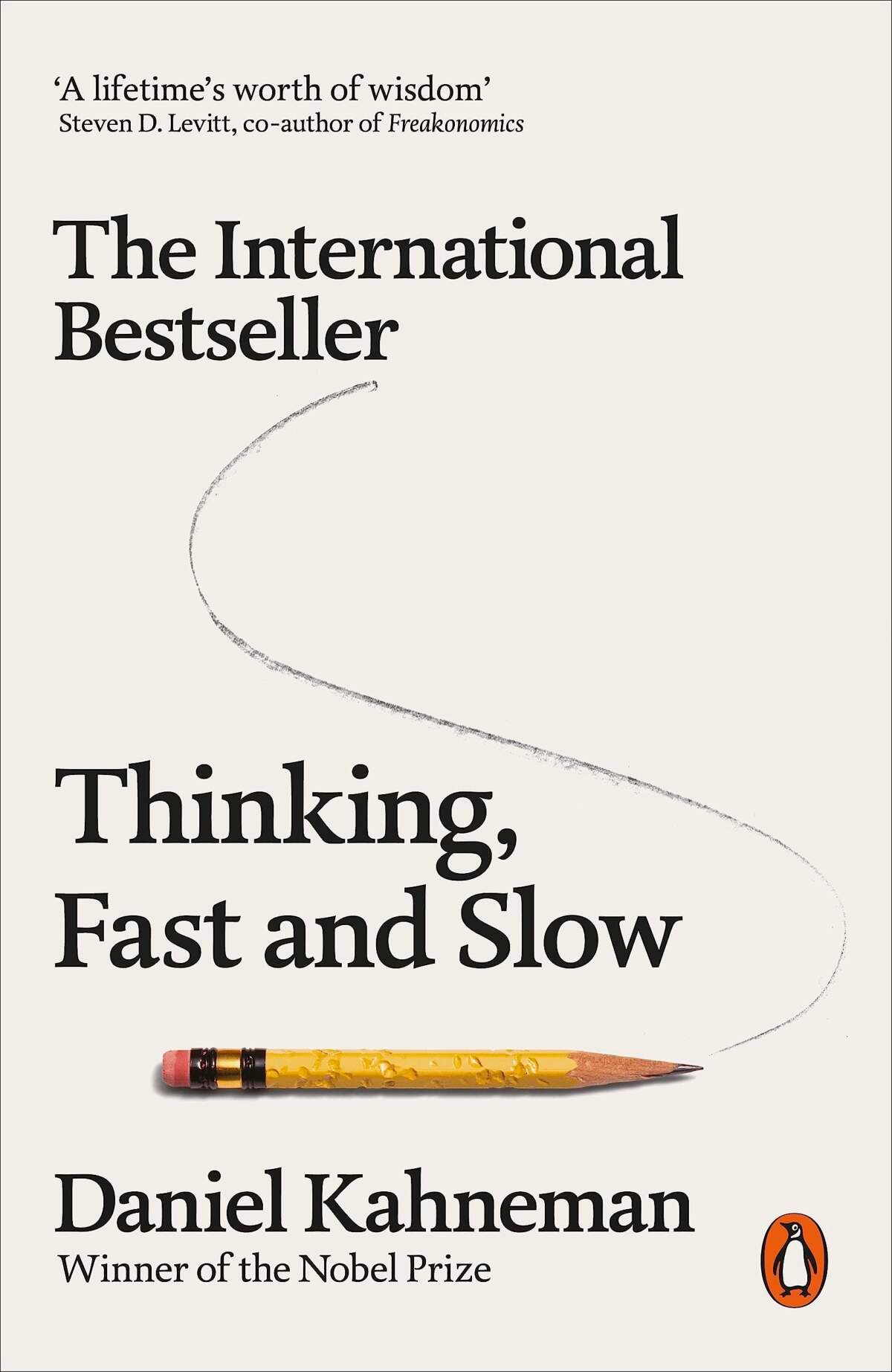

Book Summary
Daniel Kahneman
Chapter-wise summary · In my own words
PART 1: Two Systems (Chapters 1 – 9)
Everything in Part 1 boils down to one big idea: System 1 (fast, automatic, instinctive) and System 2 (slow, deliberate, lazy). Most of the chapters explore different ways System 1 runs the show—and how to wake System 2 up when it actually matters.
🧠 Chapter 1: The Characters of the Story
The book introduces two mental systems. System 1 is fast, intuitive, and automatic—it works on first impressions and gut reactions without any effort. System 2 is slow, deliberate, and deeply analytical — but it’s also very lazy. It doesn’t like working hard. The whole book is basically about how these two systems fight for control over your decisions.
👁️ Chapter 2: Attention and Effort
System 2 requires active effort — it has a blind spot and tends to ignore things in your surroundings unless you deliberately wake it up. The key takeaway: slow down, pay attention, and let System 2 do its job instead of letting System 1 rush to an answer.
😴 Chapter 3: The Lazy Controller
System 2 is described as a lazy controller. It’s supposed to be in charge, but it often steps back and lets System 1 do the work unchecked. Sometimes this leads to lazy decisions you end up regretting. That said, System 1 isn’t always wrong. Sometimes fast instinctive thinking is genuinely better. But any decision that truly matters needs the slow, conscious effort of System 2.
🔗 Chapter 4: The Associative Machine
Our brain works by association—one thought triggers another automatically. System 1 constantly makes connections in the background without you realizing it. (This chapter felt like an extension of the System 1/2 framework — same core idea, different angle.)
✅ Chapter 5: Cognitive Ease
The things we already know feel easier to process. If you know about the stock market even a little, reading about it feels comfortable. If you know zero psychology terminology (same), everything feels harder. Familiar = easy. Unfamiliar = effort. It’s like playing guitar—once it’s stored in your mental RAM, you don’t need to think hard to do it. Your brain gives you a green light on familiar things faster than unfamiliar ones.
📏 Chapter 6: Norms, Surprises and Causes
Some things are completely normal to you but surprising to others — and vice versa. Our brain is constantly building a model of what’s ‘normal’ and flagging anything that breaks from it. (Personally found this chapter a bit dry.)
🏃 Chapter 7: A Machine for Jumping to Conclusions
System 1 is built to jump to conclusions before you have the full picture. Example: If you see someone with red eyes, you immediately assume they’ve been drinking—but maybe they were studying all night, or staring at a screen, or watching too many shows. Our brain picks the first available explanation and runs with it. The full story? System 1 doesn’t wait for it.
⚖️ Chapter 8: How Judgments Happen
Closely related to the previous chapter. We make judgments extremely fast—we assume, we presume, we fill in the blanks ourselves. System 1 does most of this automatically. The problem is we don’t realize we’re doing it.
💡 Chapter 9: Answering an Easier Question
When faced with a hard question, System 1 quietly replaces it with an easier one and answers that instead. Your brain doesn’t always tell you it did this. You think you answered the real question — but you answered the convenient one. System 2 is too lazy to object. Lesson: When something feels too easy to answer, check if you actually answered the right question.
PART 2: Heuristics and Biases (Chapters 10 – 18)
Part 2 gets into the specific mental shortcuts (heuristics) and the predictable mistakes (biases) they cause. This is where the book starts connecting to real life—money, risk, statistics, comparisons.
🔢 Chapter 10: The Law of Small Numbers
Small numbers are easy to remember; large ones are not. You remember your 4-digit PIN. You don’t remember your bank account number. The brain is designed for small, manageable chunks of data — and this creates bias when we try to draw conclusions from small samples. A few data points feel more significant than they actually are.
⚓ Chapter 11: Anchoring
The things around you anchor your perception. If you’re shown ten flats in Manhattan all priced at ₹10 crore, then the 11th flat at ₹10 crore feels completely reasonable. But if you’d never seen those first ten, you might have thought ₹10 crore was outrageous. Your environment sets the reference point for every conclusion you draw—even when those reference points are completely unrelated to the thing you’re evaluating.
📰 Chapter 12: The Science of Availability
We think about things that are easily available in our memory or our environment. That’s why you think about plane crashes when you board a flight—because plane crash news is everywhere. You’ve seen it on social media, in newspapers, and on TV. It’s available. This is also why putting your goals on your wall works: constant visual availability keeps them in your head. We overestimate the likelihood of things we hear about the most.
🎲 Chapter 13: Availability, Emotions and Risk
Our emotions around risk are shaped by availability. The people in the top 1% who take big risks often do so by deliberately setting emotions aside—or by having such strong conviction that fear doesn’t dominate. For most people, emotions act as a brake on risk-taking. This isn’t always bad — sometimes the brake saves you. But sometimes it stops you from doing something that would have changed your life.
📦 Chapter 14 & 15 : Tom’s Specialty · Linda: Less is More
These two chapters had detailed examples but felt very dry. The core idea is that we make logical errors when we add extra information—more details can actually make something feel more likely to us even when statistically it becomes less likely. (Honestly found these ones a bit hard to follow—the key insight is in the name: sometimes less information leads to better decisions.)
📖 Chapter 16: Causes Trump Statistics
We are terrible at learning from general statistics, but we learn very quickly from individual stories. If I tell you ‘40% of startups fail within two years,’ it goes in one ear and out the other. But if I tell you a personal story about someone who lost everything building a startup—you remember it and you feel it. Stories beat statistics every single time in how the brain processes them.
📈 Chapter 17: Regression to the Mean
Good performance tends to be followed by more average performance—not because you got worse, but because extreme results (very good or very bad) often have luck in them. The chapter uses the example of reward and punishment in training. If you reward a great performance and the next one is average, you might think the reward didn’t help. But the performance was going to come back to average regardless. We confuse luck-driven variation with cause and effect. Bottom line: don’t only measure wins and losses. Ask yourself if you gave 100% — that’s the only thing you actually control.
🎯 Chapter 18: Taming Intuitive Predictions
We have a natural instinct to make predictions based on gut feeling. Sometimes our intuitions are genuinely valuable—sometimes they’re not. The book suggests that when something is mathematically or statistically traceable, let the numbers do the work. Intuition is most reliable in domains where you have deep, consistent experience. In new or complex situations, numbers beat gut feeling.

PART 3: Overconfidence (Chapters 19 – 24)
This section is about how badly we overestimate our own understanding, predictions, and expertise.
🌫️ Chapter 19: The Illusion of Understanding
We think we understand far more than we do. There’s an illusion — a feeling of ‘I get it’ — that is often not backed by real comprehension. The brain is so good at constructing narratives that it creates a sense of understanding even when the understanding is shallow or incomplete.
📉 Chapter 20: The Illusion of Validity
Stock analysts, financial forecasters, and experts in general are often less accurate than random predictions—or even simple formula-based models. But they can’t accept being wrong because it would shatter their professional identity. The world is constantly changing. Being wrong is not a flaw — it’s information. There is literally no harm in saying, ‘I was wrong; here’s my updated view.’ The only harm comes from the ego that refuses to update.
🧮 Chapter 21: Intuitions vs. Formulas
In a direct comparison, mathematical models consistently outperform human intuition in making predictions. This doesn’t mean intuition is useless — it means don’t let your gut override a well-built formula. Some things were built as systems precisely because individual human judgment failed. Trust the system. Don’t try to outsmart tools that were designed to correct human blind spots.
🎓 Chapter 22: Expert Intuition: Where Can We Trust It?
This one’s nuanced. Expert intuition is trustworthy in domains with consistent patterns and fast, clear feedback—a firefighter reading a burning building or a chess grandmaster reading a board. It is not trustworthy in unpredictable, low-feedback environments (stock markets, political forecasting). The gut feeling of a doctor who has seen thousands of similar cases? Valuable. The gut feeling of a pundit predicting elections? Much less so.
🌍 Chapter 23: The Outside View
When you are deeply inside a project or goal, you become too optimistic. You can only see your own version of it—and you naturally inflate its chances. The outside view, from someone who has no emotional investment, is often more accurate. An important lesson personally (and for any business): always seek external perspective, even when—especially when—you believe in what you’re building.
⚙️ Chapter 24: The Engine of Capitalism
Optimism is what drives entrepreneurs, innovators, and risk-takers — and that’s why it’s called the engine of capitalism. Most successful people are optimistic. But there’s a fine line: optimism becomes overconfidence when it stops you from seeing real risk. Being optimistic is a strength. Being blindly optimistic is how people walk into avoidable disasters.
PART 4 · Choices (Chapters 25 – 34)
This part is about how we actually make decisions under uncertainty—and why the way choices are framed changes everything.
🎰 Chapter 25 – 30: Prospect Theory & Decision Making
Kahneman introduces prospect theory—the idea that losses feel about twice as painful as gains feel good. A 50/50 gamble of winning ₹1,000 or losing ₹1,000 is unappealing to most people even though it’s mathematically neutral—because the potential loss hurts more than the potential gain feels good. This is why we focus on negatives. Something bad that happens to you will affect you more deeply than something equally good. It’s hardwired. The practical lesson: consciously practice gratitude for what goes right—because your brain won’t do it automatically.
🌋 Chapter 31 – 32: Rare Events
We systematically either overestimate or underestimate the probability of rare events. When a rare event is vivid and available (plane crashes or earthquakes), we overestimate it. When it’s abstract and distant, we ignore it entirely even when it’s genuinely likely. Smart decision-making means thinking about both—not being paralyzed by what might happen, but not pretending rare risks don’t exist either.
PART 5 · Two Selves (Final Chapters)
The last section of the book zooms out—from individual decisions to a bigger question: what actually makes a life feel good?
🌟 Chapter Final: The Two Selves & Wellbeing
Kahneman distinguishes between two ways of experiencing your life: the experiencing self (what you feel moment to moment) and the remembering self (the story you tell about your life). These two selves often disagree. The big final message: the things we’re currently most stressed about are often not as significant as they feel. And life satisfaction — that big-picture sense of ‘my life is going well’ — is very different from day-to-day happiness. The second one is actually more achievable. You don’t need life to be perfect. You just need to find small things to genuinely enjoy each day.
Rating: It’s good. Read it.

Leave a Comment