
Book Blog
Understanding is not the accumulation of knowledge. It is the perception of truth as it is, from moment to moment, without the burden of yesterday.
Why I Read This Book
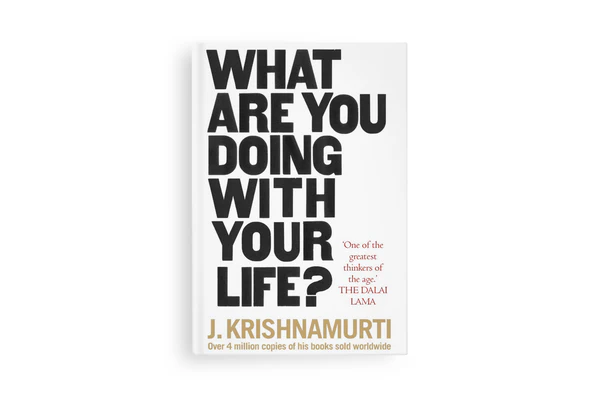
This is one of my favorite books—by Jiddu Krishnamurti. It is the kind of book that asks you uncomfortable questions and refuses to give you easy answers. Krishnamurti doesn’t tell you what to think or how to live. He asks you to observe yourself, your thoughts, your fears, and your relationships without judgment and without escape. That is both the simplest and the most difficult thing he asks of you.
The book is divided into four sections: yourself and your life; self-knowledge as the key to freedom; education and work and money; and relationships. Below are my chapter-by-chapter notes—written in my own words, for my own reference and for anyone who wants to understand this book without having to wade through dense philosophical language.
I will say this upfront: this is not an easy read. But it is a deeply honest one. And once it gets into your head, it stays there.
SECTION 1
Yourself and Your Life
Seven chapters on who you are, what you want, and why understanding your mind is the only honest starting point.
Chapter 1: What Are You?
Krishnamurti begins with a deceptively simple question: do you understand your own mind? Because without understanding the mind, you cannot honestly understand any crisis in your life. The mind is not a problem to be solved — it is the very instrument through which you meet life.
The key insight here: self-knowledge is not something you gain by sitting alone in a room or retreating from the world. The myth that isolation leads to awareness is firmly cleared up in this chapter. Self-knowledge comes when you are in a relationship—when you observe yourself reacting to people, to situations, to ideas. You see your patterns when you are in action, not when you are hiding from it.
Krishnamurti also addresses change directly. There is, he says, no real difference between the old and the young when both are equally enslaved to their desires. Maturity is not a matter of age—it is a matter of understanding. The problem is that most of us want someone else to do the changing for us. We wait for the revolution. We remain inactive until the outcome is guaranteed. That waiting—for security, for certainty before we act—is itself a form of unintelligence.
Chapter 2: What Do You Want?
This chapter asks an even harder question than the first. What exactly are you running after? Most people say happiness—but Krishnamurti is precise: happiness cannot be pursued. The moment you chase it consciously, it slips away. You cannot go after happiness the same way you go after a promotion or a product.
What most people are actually chasing is gratification — the feeling of having achieved, acquired, or been fulfilled. There is also a search for something permanent: a feeling, a relationship, a certainty that will not dissolve. We search for permanence because inside ourselves, we feel so uncertain.
There is a beautiful and uncomfortable line in this chapter: the moment you are conscious that you are happy, it is no longer happiness. True happiness is not something you possess — it is a by-product of living rightly.
He also touches on dependency. Most of what we call happiness is built on something we depend on—a person, a habit, a circumstance. And the difficult truth he asks us to sit with is this: even surrounded by family and people we love, at a psychological level, we are completely alone. There is no permanent psychological security in another human being. This is one of the most difficult truths to accept—and one of the most liberating.
Chapter 3: Thought, the Thinker, and the Prison of the Self
Where do thoughts come from? Mostly from the past — memories, fears, old patterns — and from projections into the future. You cannot stop thoughts from coming. But you can observe them rationally, ask why they arise, and in doing so begin to understand yourself more clearly.
We cannot bring about radical change to our thinking by force. We cannot simply decide to stop feeling afraid or sorrowful and expect the feeling to disappear. Sorrow, in particular, cannot be ended through more thinking. Thought cannot dissolve sorrow—it can only analyze it. And analysis is not the same as freedom.
The only way to genuinely move through sorrow, loneliness, or any disturbing pattern is to observe it without pressure—without the compulsion to fix it, escape it, or name it. Just observation. Complete, open observation. When the mind is still enough to look without agenda, a mutation happens — not gradually, but completely.
If you cannot manage your thoughts, your life is driven by something you cannot control. That, Krishnamurti says quietly, can become a kind of tragedy.
Chapter 4: Insight, Intelligence, and Revolution in Your Life
Intellect and intelligence are not the same thing. This is one of the most important distinctions in the book. Intellect is the capacity to argue, analyze, debate, and memorize. Intelligence is something deeper — it is when the mind and the heart work in the same direction. When your thinking and your feeling are unified and honest.
The way to develop this kind of intelligence is through understanding. And the only path to understanding is through quiet, non-reactive observation. When you slow down and observe rather than immediately respond, things become clearer. “Easy” is too weak a word—they become honest.
Krishnamurti also makes a distinction between knowledge, wisdom, and intelligence. Knowledge is accumulated information—it can be stored, taught, and passed on. Wisdom is something different entirely. It cannot be bought or marketed. It is a realization that arises within you—from watching the rich and the poor, the powerful and the lonely; from understanding life through direct observation. Wisdom is living insight. Intelligence, meanwhile, is greater than both—it arises only when there is genuine self-knowledge, when you truly understand the total process of what you are.
Chapter 5 · Escape, Entertainment, and Pleasure
Technology has given us more leisure than any previous generation. The question is what we do with it. Krishnamurti observes that most people use leisure to forget themselves—religion, entertainment, travel, social media, alcohol, relationships—anything that creates a distance between you and the experience of being yourself.
The most powerful escape discussed here is pleasure—and why sex, in particular, has become such a central problem. The pattern is simple: anything that gives pleasure, we want more of. The more we want, the more dependent we become. The more dependent we become, the more we fear losing it. What begins as pleasure gradually becomes a compulsion, and then a problem.
This does not mean pleasure is wrong or must be eliminated. The point, Krishnamurti says clearly, is to understand pleasure—not destroy it. You cannot destroy it. But if you pursue pleasure mechanically, without awareness, it becomes a source of confusion, false values, and illusion.
There is a beautiful passage here about emptiness. Some people are empty inside — they feel hollow — and they spend their lives filling that hollowness with noise. But Krishnamurti suggests that emptiness, properly understood, is not a problem to be solved. You cannot fill a cup that is already full. To receive something beautiful and true, you need to be empty. Being empty is not the same as being lost.
Chapter 6 · Why Should We Change?
Every self-help book asks this question, but Krishnamurti asks it differently. He is not interested in change as a social performance. His question is, “Why do you actually want to change, and who is doing the changing?”
We want to change because we are dissatisfied with what we are. We see conflict, disturbance, and something that needs to be better. But the problem is that most change happens at a surface level—we adjust behavior, modify habits, and adopt new routines—while the fundamental psychological patterns remain untouched. We know what to do. We even know how to do it. But we are never fundamentally convinced why, and so nothing truly changes.
Real transformation is not outward. It is psychological—and it comes only after genuine observation, analysis, and understanding. The change in values, in the principles you live by, and in what you call knowledge and wisdom and intelligence—that is the only change that actually matters.
We waste enormous energy resisting change while simultaneously claiming we want it. That contradiction is worth sitting with.
Chapter 7: What is the Purpose of Life?
This is the chapter that almost every young person eventually comes to—and usually at the wrong time, when they’re too busy looking for an answer to actually observe the question.
Krishnamurti’s response is characteristically honest: the purpose of life cannot be handed to you by a guru, a religion, a career counselor, or a self-help book. The moment you follow someone else’s answer, you have given up the search. True purpose — real significance — can only be found when you stop following and start questioning. What do you love? What do you believe? What kind of change do you think is necessary? These are not questions with external answers.
We are, he says, deeply confused—and out of that confusion we seek validation, compliments, and certainty. We want to be told we are doing it right. All of this seeking for approval and security turns us into a kind of slave. And we are so confused that we cannot even describe the significance of our own life to ourselves.
The person who is genuinely engaged with life does not ask, “What is the purpose of life?” They are too busy trying to understand and dissolve the confusion and sorrow in which they are caught. Purpose is not a destination. It is found in right relationships, right action, and love. When there is love—not as sentiment, but as a living quality of attention—that love is its own purpose. That love is what people have called God.
SECTION 2
Self-Knowledge: The Key to Freedom
Nine chapters on fear, anger, sorrow, jealousy, desire, loneliness — and what it actually means to understand yourself.
Chapter 1: Fear
Fear takes two forms: outer and inner. Outer fears are practical—losing a job, not having enough to eat, losing social position. Inner fears are more subtle and more damaging — fear of failure, fear of death, fear of loneliness, fear of not being loved.
Not all fear is bad. Physical fear that protects the body is intelligent—it is your biology doing its job. Psychological fear is the problem. And the first step toward psychological freedom is to actually identify what you are afraid of, clearly and honestly. Most of us don’t do this. Instead, we develop elaborate escape routes—habits, distractions, and relationships—that allow us to avoid confronting the thing we fear.
The origin of fear, Krishnamurti says, is thought. And thought about what? Mostly about pleasure — the pleasure we have and are terrified of losing. If you are so absorbed in the present moment that you are not projecting into a feared future, fear does not arise. Fear lives in time — in the gap between what you have now and what you might lose tomorrow.
The deepest root of all fear is the ego, the sense of ‘me.’ When there is no observer — no self desperately clinging to its image and its securities — fear begins to dissolve.
Chapter 2: Anger and Violence
Simple, sudden anger — a flare-up that is felt and forgotten — is one thing. It may even have a legitimate physiological cause. But the anger that is slowly brewed, deliberately nurtured, and used to hurt and destroy is another matter entirely and far more dangerous.
We rarely express anger at the moment we feel it. We don’t want to disturb relationships. So we accumulate resentment, bitterness, and jealousy layer after layer. And over time, these accumulations seep into our behavior. We start blaming others for reactions that are actually our own unresolved disappointments.
Anger also feeds on dependency. The more dependent you are on someone for your happiness, the more you expect from them — and the more violently disappointed you become when they fail to meet those expectations.
The antidote is not suppression. Suppression simply buries the anger deeper. The antidote is understanding—and, where appropriate, forgiveness. Real forgiveness, though, is not a performance. You have to genuinely mean it. Forgiveness is not for the other person as much as it is for your own mental health.
On a broader level, the world’s violence follows the same logic: competition for resources, the desire for power and position, and the stronger dominating the weaker. These are not problems outside of us. They are problems within us, expressed outward.
Chapter 3: Boredom and Interest
Here is an insight that surprised me: boredom can itself become an escape. If we are overwhelmed by sorrow or anger, boredom—the numbness of doing nothing interesting—can feel like a relief. We drift into it deliberately, without realizing we’re doing it.
Krishnamurti’s instruction is simple but very hard: do not escape from your emotions. If you are bored, stay with it. Feel it. Try to understand it. What is boredom actually pointing to? If you are not interested in understanding why you are bored, you cannot simply force yourself to be interested in an activity.
Boredom often indicates emotional exhaustion. We have tried so many things and chased so many stimulations and sensations that we have become weary. The mind needs rest — genuine rest, not entertainment disguised as rest.
And here is the insight about relationships: one of the most common reasons relationships fail is that the stimulation we get from another person eventually ends. The excitement, the novelty, the happiness — it fades. And instead of understanding why, we label it boredom, and we want out. True interest—in anything or anyone—cannot be based on what we are getting from it. The moment the reward stops, interest built on the reward also stops.
Chapter 4: Self-Pity, Sorrow, and Suffering
People try everything to suppress sorrow. They drink. They seek entertainment. They stay busy. But sorrow stays. It returns. It grows in the dark.
The problem is not sorrow itself. The problem is that we try to deny it, to outrun it, to make it disappear. What we actually need to do is understand it: what is this sorrow? Where does it come from? What is its nature?
Sorrow can come from loss, from unfulfilled capacity, from being denied an opportunity, and from loneliness. Self-pity — conscious or unconscious — is a component of sorrow. It is the feeling of being the victim, of blaming circumstances for what is happening inside you.
When something is physically wrong with us, we see a doctor. But when we suffer emotionally, we try to suppress, escape, and distract. Over time the suppressed emotion grows into something larger.
Krishnamurti asks directly: Do you want to escape from suffering, or do you want to be free from it? These are different things. Escaping is what most of us are already very good at. Freedom requires you to stop running — to be aware of the suffering without judgment, without condemnation, without immediately trying to fix it. In the act of genuine understanding, sorrow begins to release its grip. Not because you defeated it, but because you finally listened to it.
Chapter 5: Jealousy, Possessiveness, and Envy
Jealousy, Krishnamurti says quietly, is not love. This is hard to hear because we often confuse the two. We think the intensity of our jealousy proves the depth of our love. But what jealousy actually proves is the depth of our dependency and our fear of losing what we cling to.
We become jealous of something until we find something else to cling to. The underlying drive is not love — it is fear: fear of being alone, fear of being without the security that another person or thing provides.
Attachment — to things, to people, to reputation — gives us pleasure. But it also breeds jealousy, anxiety, and pain. Physical dependence on one another is natural and inevitable; we are social creatures. But psychological dependence—the kind where your sense of self, your happiness, and your identity are tied to another person—breeds anxiety, jealousy, and fear. And that kind of attachment is not love.
There is also a larger cultural dimension here. Our present culture is built substantially on envy — the acquisitive desire for what someone else has. Ambition is envy in action. Competition is envy institutionalized. And envy, unchecked, drives division and eventually conflict.
A final line worth sitting with: what parents often call duty toward their children is frequently not love—it is a form of compulsion, covered with the name of love and approved by society. Real love does not compel.
Chapter 6: Desire and Longing
Desire is not a problem to be eliminated. This is crucial. Krishnamurti does not ask you to destroy desire—he asks you to understand it.
Most desire follows a simple pattern: you see something beautiful or pleasurable, you want to hold onto that feeling, and gradually the desire for more intensifies. This applies to objects, to experiences, and to people. The moment you taste something pleasurable, you want it repeated—and that repetition is where desire begins to darken into obsession.
The escalation of desire is easy to observe once you know the pattern. There is always a better version available. There is always more to want. And so we keep designing new desires, running toward a perfection that does not exist. In doing so, we can ruin what is real, beautiful, and present — chasing what is merely imagined.
When desire is out of your control—when you do not understand it, cannot observe it clearly—it controls your life. The antidote is not suppression. The antidote is awareness: knowing why you want what you want, seeing the pattern clearly, and making conscious choices rather than being driven unconsciously.
If you try to forcibly destroy desire, you may destroy something extraordinary and beautiful in the process. The goal is not the absence of desire. It is the presence of awareness.
Chapter 7: Self-Esteem: Success and Failure
Self-esteem, in Krishnamurti’s reading, is a psychological trap. We spend enormous energy constructing and protecting a self-image—a sense of who we are, what we stand for, and what position we hold. And then we live in constant fear of anything that threatens that image.
True self-awareness, he says, eliminates this need entirely. When you genuinely understand who you are—without flattery, without performance—you don’t need to explain yourself, seek validation, or prove your worth. The urge to be ‘somebody’ dissolves.
Conventional success and ambition, he argues, are defenses against the terror of being a nobody. To escape that insecurity, we become a judge, an engineer, a minister—we build an identity that the world will recognize. But this driven, identity-protecting mind becomes rigid. It cannot think clearly. It cannot love freely.
The distinction he draws between ambition and genuine interest is sharp: ambition is a competitive engine fuelled by the craving for validation. Genuine interest means you do something because you love it—not to defeat anyone, not to win a title, but because the act itself is its own reward.
The pursuit of status and success is ultimately an escape from inner emptiness. Meaning cannot be found in a future achievement. It is found in right relationships and right action—now, in this moment. And love — real love — is impossible as long as the mind is consumed by ambition and competition.
Chapter 8: Loneliness, Depression, and Confusion
Loneliness and aloneness are not the same thing. Loneliness is isolation—the mind enclosing itself, cutting itself off from everything. It is accompanied by fear, by a desperate need to connect and be seen. Aloneness is something different: it is a state of inner completeness, where solitude feels like freedom rather than punishment.
The deeply depressed person is trapped in loneliness. The person who has genuinely understood themselves begins to discover that being alone with one’s own mind can be both productive and peaceful.
We try to escape loneliness through socializing, cinema, relationships, noise—anything that fills the silence. But these escapes are temporary. The loneliness returns. Krishnamurti’s suggestion is radical: instead of escaping, sit with the loneliness. Observe it. Be aware of it without fighting it. Don’t give it a name immediately; don’t layer it with judgment. Just be with it. In that awareness, something can shift.
He also makes an important distinction between introspection and awareness. Introspection is looking inward with the goal of improving or changing yourself. It is always self-referential, always oriented toward a result—and when the result is not achieved, it produces moodiness and depression. Awareness is different: it is observation without agenda, without judgment, without the compulsion to fix anything. Awareness does not contaminate what it observes. Introspection does.
On confusion: most of our psychological and even physical diseases come from confusion—the clash of accumulated beliefs, opinions, desires, and fears. We are so weighed down by other people’s opinions and our own conditioning that we cannot see clearly. Accepting that you are confused—genuinely acknowledging it, rather than pretending to a clarity you don’t have—is the first honest step toward understanding.
Chapter 9: Self-Ending, Not Self-Improvement
This is perhaps the most challenging chapter in the book and certainly the one most at odds with the self-improvement industry.
Krishnamurti’s argument is this: standard self-improvement — the determined effort to be better, to modify habits, to become ‘more’ of something — never actually frees the mind from sorrow. It may change behavior at the surface. But the psychological structures beneath remain. In fact, by treating yourself as a project to be improved, you strengthen the very ego-self that is the source of suffering.
We confuse outward progress — better technology, better systems, better habits — with inward transformation. They are not the same. The human psyche does not improve the way a phone improves.
Real freedom from sorrow requires something Krishnamurti calls it ‘self-ending’—not suicide of the self, but the complete cessation of the becoming process, the constant effort to be more, to achieve more, to evolve into a better version. When that process ends — when you are no longer trying to become something — there is a space for something genuine to emerge.
Sorrow does not end through improvement. It ends through understanding. And understanding is not a gradual accumulation—it is a flash of perception that comes when the mind is quiet, honest, and no longer running from itself.
SECTION 3
Education, Work, and Money
Four chapters on what education is actually for, how to find right work, and whether any of this makes sense in a broken society.
Chapter 1: What is education?
The ignorant person is not the one who has not read many books. The ignorant person is the one who does not know themselves. The learned person, meanwhile, can become a different kind of fool—one who relies so heavily on accumulated knowledge and external authority that they lose the capacity for direct understanding.
What we call education today has been largely reduced to the gathering of facts and the acquisition of technical skills. And this narrowness, Krishnamurti says, has caused enormous confusion and conflict—because it produces people who are technically capable but psychologically illiterate.
The original purpose of education was to help us understand what we are. To observe. To see our own thoughts clearly. To live with awareness. But we were never taught any of this. We were taught how to earn a living and then left to figure out how to live on our own.
The result is that psychological pressure — conflict, fear, sorrow, jealousy — overwhelms us, and no technical skill in the world helps us deal with it. Even the most educated, the most successful, find themselves unable to handle their inner lives. And no vacation, no distraction, will resolve something that requires understanding rather than escape.
Real education would not encourage us to conform to society’s values blindly. It would help us discover our own values through honest investigation and self-awareness. It would not make us better machines. It would make us more fully human.
An important distinction: knowledge is an accumulation of the past. Learning is always happening in the present. Real education is not about loading you with the past. It is about keeping you alive, curious, and capable of learning right now.
Chapter 2: Comparison, Competition, and Cooperation
From childhood, we are compared to siblings, to classmates, to some imagined standard of performance. And what does this comparison produce? Fear. Not the productive kind. The kind that makes you afraid of being yourself.
Krishnamurti does not pretend that competition is easy to step away from. He acknowledges that as long as you live in a competitive society, you will feel competitive pressure. The problem is not competition itself—it is the desire to compete, the hunger for status, success, and the approval of others that drives us to treat every situation as a contest.
Real cooperation is only possible when there is no self-interest in the outcome — when ‘I’ and ‘you’ are not competing for the same prize but are both interested in the action itself rather than the result. This kind of cooperation is rare. But it is the only kind that produces something genuinely good.
A society that teaches only competition cannot produce cooperation. But a society that teaches only cooperation without individual understanding produces conformity. The question is not which one to choose—it is how to become the kind of person for whom cooperation is natural, because there is no fear driving you to compete.
Chapter 3: Work: How Do You Decide?
To understand what work you want to do, you first need to understand what you love. And to find out what you love, intelligence is required — not intelligence in the technical sense, but the willingness to look honestly at yourself without the interference of fear.
The problem is that from childhood, we are taught to become an engineer, a doctor, or a lawyer—paths that promise financial security and social approval. And because the fear of not earning a livelihood is real, we follow those paths. We follow what every successful person before us has done. We fit ourselves into a plan.
But what if you didn’t? What if there was no fear? What would you actually love to do?
Goodness — real goodness, not respectability — comes only when there is intelligence, love, and the absence of fear. You can be socially respectable and deeply unfree. Society will call you a good person. But that is not the same as being good.
On right livelihood in a wrong society: Krishnamurti is honest here. In a society built on competition, envy, and the pursuit of power, a truly right livelihood is very difficult. But you can be conscious of what you are doing. You can be aware. You can choose to operate with integrity even within a broken structure—and that awareness itself is a form of right action.
The truest work of a human being, he says, is to discover truth. In that discovery, and in the love that comes with it, a new kind of relationship — and eventually a new kind of world — becomes possible.
Chapter 4: What is the Basis for Right Action?
Why do we want to change our actions? Because we are dissatisfied with what we are. We want something better. There is a constant impulse to improve, to correct, to do something differently.
But right action cannot come from a mind that is conditioned—reacting automatically to what society expects, to what has always been done, and to what seems safe. Right action requires a quiet, observant mind: one that is free from self-centered motive and the noise of accumulated opinion.
The basis is not a moral code handed to you from outside. It is not following a tradition or obeying an authority. The basis for right action is self-knowledge—genuine, honest understanding of the total psychological process of what you are. When the mind and the heart are working in the same direction, action arises naturally and rightly from that integration.
This is not about being perfect. It is about being honest. A person who acts from real understanding — not from fear, not from ambition, not from the need for approval — acts rightly. Not because they are trying to. But because there is no friction between what they see and what they do.
SECTION 4
Relationships
Seven chapters on what a relationship actually is—marriage, love, sex, passion, truth, God, death, and the meditation that holds it all together.
Chapter 1: What is a Relationship?
Are you in a relationship with another person — or are you in a relationship with the image you have created of them in your head? This is the real question.
Krishnamurti says that most relationships are not actually between two people. They are between two images—the image you have of yourself and the image you have constructed of the other person. You respond to that image, not to who the person actually is. And when the person behaves differently from the image, conflict arises.
A true relationship requires looking at another person without the accumulated image—without the story you have built up about who they are, what they mean to you, and what they should be. This requires a great deal of attention and awareness. It is, he says, one of the most difficult things a human being can do.
A relationship is not dependency. Most of what we call a relationship is dependency—we need the other person for our happiness, our sense of security, and our feeling of being loved. This need breeds fear of losing them, and that fear is what creates jealousy, possessiveness, and control.
For a relationship to work — for it to be something more than mutual dependency — both people need to be capable of looking at themselves honestly. Not judging each other’s actions, but understanding the reactions within themselves. Most conflict in relationships comes not from the other person’s behavior but from our own unexamined expectations and fears.
Chapter 2: Love, Desire, Sex, and Dependency
Where there is dependency and attachment, there is no love—there is only fear of losing what you cling to. This is a difficult thing to accept, because most of us have been taught that love is precisely this attachment, this desperate wanting.
Real love, in Krishnamurti’s understanding, is not about possession. It is not about seeking. It comes when you understand another person deeply—when you genuinely care for them without calculating what you will receive in return. Love is not a transaction. It does not keep score.
On sex: it is a real source of pleasure and intimacy between people. There is nothing wrong with it. The problem begins when pleasure becomes a compulsion—when one experience is not enough, and the desire for more escalates into a cycle that cannot be satisfied. This is not a problem unique to sex; it is how the mechanism of desire works in all areas of life. The more you want, the more dependent you become. And dependency, in any form, is not love.
Chapter 3: Family, Society: Relationship or Exclusion?
Family gives us our first experience of love and belonging—but it can also be the first place we learn exclusion. When love is confined to ‘my family,’ ‘my people,’ or ‘my community,’ it automatically excludes everyone outside that boundary. This exclusion, Krishnamurti says, is not love — it is a more intimate form of tribalism.
Society is a larger version of the same pattern. We build structures — nations, religions, castes, economic classes — that protect ‘us’ from ‘them.’ And we call this order. But order built on exclusion is fragile and ultimately violent because it depends on maintaining the division.
The question he puts forward: Is it possible to love without limitation? Not the love of ‘my son’ or ‘my country’—but love as a quality of attention directed without boundary? He thinks it is. But it requires understanding, first, why we cling to the exclusions we do—what fear underlies the boundary.
Family, in this reading, is not an end in itself. It is a training ground for relationships. If you learn to be honest, attentive, and non-possessive within your family—if you can love without controlling—you carry that quality into the world.
Chapter 4: Marriage, Love, and Sex
Marriage, as most people live it, is a contract built around mutual need. We come together because we are lonely, because we desire security, because society expects it—and we call this love. But Krishnamurti is precise: love is not need. The moment love is a transaction—I give you this, and you give me that—it is no longer love. It is an arrangement.
This does not mean marriage is wrong. It means we need to be honest about what we are actually entering into. If you marry out of loneliness, you will bring that loneliness into the marriage. If you marry out of fear of being alone, the fear does not disappear — it simply takes a new form inside the relationship.
Love, properly understood, cannot be cultivated, cannot be practiced, and cannot be worked at. A mind that is free from jealousy, from possessiveness, and from the constant demand to be satisfied—that mind can love. But a mind tangled in its own fears and needs cannot love, no matter how sincerely it tries.
On sex: the reason it becomes such a dominant problem in people’s lives is that, in most areas of daily existence—work, social life, ambition—we are deeply unfree. Sex becomes the one space where freedom feels possible. And so all the energy that cannot find expression elsewhere floods into that single channel. The problem, then, is not sex. The problem is the narrowness and unfreedom of everything else.
Real love has no tomorrow and no yesterday. It is not a memory, and it is not a promise. It exists only when the mind is completely present—not calculating, not demanding, not afraid.
Chapter 5: Passion
Passion, the way Krishnamurti uses the word, is not desire. Desire is personal — it is wanting something for oneself. Passion is something larger and less self-centered: an intensity of engagement with life that is not seeking any particular result.
Most people have experienced passion only in a narrow sense—passion for a person, for a cause, for a career. But this kind of passion inevitably fades when the object of passion changes or disappoints. That is not the passion Krishnamurti is pointing toward.
The passion he describes is a quality of the mind that is fully awake. A mind without the deadening weight of accumulated sorrow, without the constant interference of self-interest, perceives life with an intensity that is itself a kind of love. It is not manufactured. It cannot be cultivated through effort. It arises when the mind stops seeking its own satisfaction long enough to actually look at what is.
This kind of passion is also the basis for true action in the world. Not action driven by ideology or ambition, but action that comes from clear seeing—from a mind that perceives a problem and responds to it without the distortion of personal motive. That response is passionate and precise at the same time.
Without this quality — this aliveness to the present moment — life becomes mechanical: a routine of habit and repetition. We go through the motions. We call it living. But passion, in Krishnamurti’s sense, is what makes life feel real.
Chapter 6: Truth, God, and Death
These three subjects — truth, God, and death — are usually treated as separate questions. Krishnamurti treats them as one. Because they all point to the same thing: what lies beyond the known, beyond the self, beyond the accumulation of memory and experience that we call ‘me.’
Truth, he says, cannot be reached through belief. The moment you adopt a belief — however beautiful, however ancient — you have substituted a word for the actual thing. A map is not the territory. A name for God is not God. Truth is something living, encountered freshly by a mind that is not carrying yesterday’s conclusions into today.
On God: Organized religion has, in most of its forms, made God into an authority—something to submit to, something to fear, something to bargain with. But Krishnamurti suggests that the sacred, if it exists at all, can only be encountered by a mind that is completely quiet — not performing, not seeking, not afraid. You cannot find the immeasurable with a measuring rod.
On death: We fear death primarily because we cling to the known—to our accumulated identity, our relationships, and our sense of continuity. The ‘me’ that has been built up over a lifetime does not want to end. But Krishnamurti points out that this clinging is itself a kind of death — a death to the present, because we are always trying to preserve the past.
To truly understand death, he says, you must be willing to die psychologically while still alive—to let go of the image you have built of yourself, to stop protecting the past, and to be finished with yesterday completely when the day ends. A mind that can do this does not fear physical death in the same way. It already knows what it means to let go.
Chapter 7: Meditation is Attention
This final chapter is one of the most important in the entire book—and it brings together everything that has come before. Meditation, for Krishnamurti, is not a technique. It is not sitting cross-legged, repeating a mantra, controlling the breath, or reaching a special state of mind. All of that, he says, is just another form of escape.
Meditation is attention. Pure, choiceless, nonjudgmental attention—to what is happening right now, inside and outside of you. When you are completely attentive to a thought as it arises—not labelling it, not trying to change it, and not following it into a story—something extraordinary happens. The thought loses its grip. The mind becomes quiet — not because you forced it to be quiet, but because you gave it your full, honest attention.
This kind of attention cannot be practiced for twenty minutes each morning and then abandoned for the rest of the day. It is a quality of being that either pervades your entire life or is not really present at all. Every conversation, every task, every moment of walking or eating or listening can be done with this quality of full attention. That is meditation.
Attention also brings clarity. A mind that is genuinely attending is not projecting, not distorting, and not running its old programs. It sees what is actually there. And that clear seeing — that direct perception of what is — is what Krishnamurti means by intelligence, by love, by the sacred. They are all the same quality of mind.
The book ends where it begins: with the invitation to look. Not to believe, not to follow, and not to improve yourself—but to look, honestly and completely, at what you are and what your life is. That looking, if it is genuine, is its own transformation. Nothing more is required.
My Overall Take
This book does not give you answers. It gives you better questions. That is unusual for a book — and deeply valuable.
Krishnamurti will frustrate you if you come looking for a system or a method. He explicitly does not want to give you one. But if you come willing to observe yourself, your thoughts, your fears, and your relationships honestly and without escape, this book will change how you see yourself.
The chapters I found most striking: the one on self-pity and sorrow (Chapter 4, Section 2)—the idea that you cannot understand sorrow by running from it. The one on loneliness and aloneness (Chapter 8, Section 2)—the distinction between the two is something I had never considered clearly before. And the final one on self-ending rather than self-improvement — which directly challenges everything the personal development industry is built on.
Read it slowly. One chapter at a time, with space in between. It is not a book to rush.
The question is not whether you will find God, purpose, or happiness. The question is whether you are willing to look honestly at yourself, at your relationships, and at the life you are actually living. That willingness, if it is genuine, is already the beginning of understanding. — J. Krishnamurti


Leave a Comment